
Why Curiosity Isn't Enough
When you stop chasing symptoms, you need a framework for what comes next.

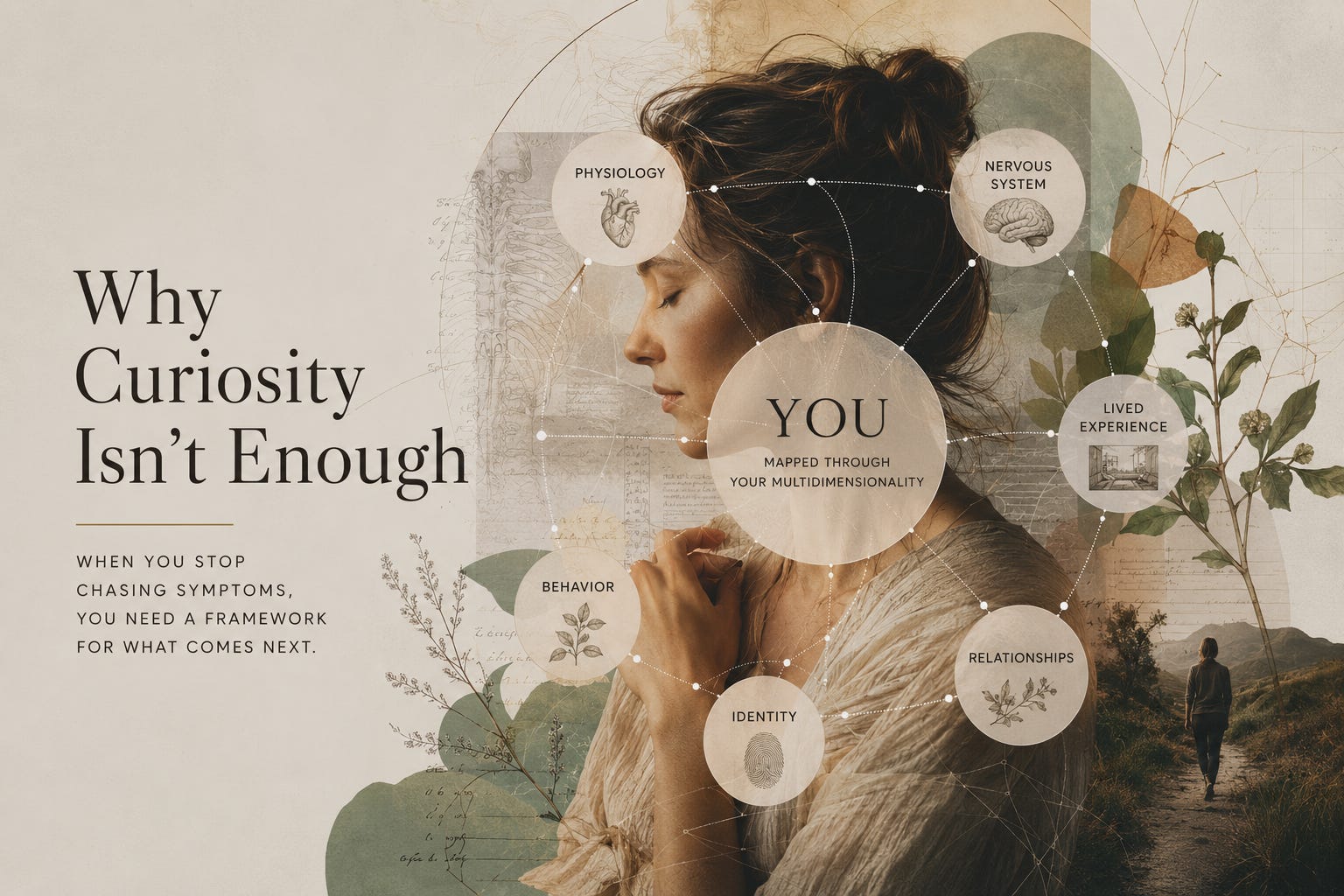
Questions are part of the tapestry I’m woven from.
I’ll happily come at one presentation from fifteen different angles, distilling every bit of information into an answer that makes sense from an all-encompassing perspective.
Over the years, I’ve come to appreciate the value of asking not just good questions, but great ones. Perhaps more importantly, I’ve learned the value of knowing which question to ask when.
That, I’ve learned, is as much an art as it is a science.
I’ve also come to understand that when we step away from chasing symptoms and step into curiosity, we quickly realize something else:
Curiosity, by itself, isn’t enough.
In fact, I think curiosity without a framework for organizing complexity can become its own kind of overwhelm.
If every symptom could be an adaptation...
If every symptom could be protecting something...
If every symptom could be connected to another system...
If every symptom could be revealing something different...
Where do you begin?
If every question leads to another, but you don’t have a framework for organizing them, you don’t end up with a deeper understanding.
You end up overwhelmed by possibility.
You know, as a practitioner, if you sit with a client long enough, asking one good question inevitably leads to another.
And another.
And another.
Before long you’ve uncovered:
childhood trauma
mold exposure
chronic constipation
nutrient deficiencies
relationship stress
nervous system dysregulation
thyroid dysfunction
grief
Each of these details matters.
But they don’t all matter in the same way.
Assuming they do is where so many practitioners get stuck.
Not because they aren’t asking good questions...
but because they don’t have a way to organize what their curiosity uncovers.
Without a proper framework, everything starts to feel equally important.
And when everything feels equally important, you don’t get any closer to understanding what’s actually organizing the person’s experience.
Our job actually isn’t to collect information.
It’s to organize it.
Collecting information and organizing it are two very different skill sets.
Most of us have become exceptionally good at gathering data.
Reading labs.
Taking timelines.
Asking better questions.
Identifying patterns.
But the information that comes from the process of collecting doesn’t naturally organize itself.
It has to be arranged.
That’s what a good framework does.
It gives you a place to put what you’ve found while preventing any one piece of information from existing in isolation.
Without a framework, every symptom, every lab, every life event, every emotional experience, every trauma, every relationship, and every physiological finding exists as its own separate piece of information.
Eventually you’re left holding a thousand puzzle pieces...
without knowing what picture you’re trying to build.
I am learning that the most effective framework doesn’t organize people by symptoms.
It organizes them by relationship.
Symptoms don’t exist in isolation.
Neither do hormones.
Or trauma.
Or beliefs.
Or life experiences.
Nothing tells the whole story on its own.
Everything is understood through relationship.
A symptom relates to physiology.
Physiology relates to the nervous system.
The nervous system relates to lived experience.
Lived experience shapes identity.
Identity influences behavior.
Behavior changes physiology.
Can you see how the moment you stop asking,
“What is this?”
and start asking,
“What is this in relationship to?”
everything begins to reorient itself?
Not because more information suddenly becomes available.
Because you’ve started organizing the information you already have differently.
The framework doesn’t change the information.
It changes your relationship to it.
Let me give you an example.
Imagine someone comes to you with chronic symptoms they’ve been trying to “fix” for years.
They’ve tried elimination diets.
Supplement after supplement.
Protocol after protocol.
They’re constantly searching for the next answer that will finally make the symptom disappear.
A symptom-based approach naturally asks,
“What else can we do to get rid of this?”
The framework I use asks a different question.
What is this symptom in relationship to?
As I begin mapping their ecosystem, a different picture starts to emerge.
The symptom isn’t just related to physiology.
It’s also in relationship to a person who doesn’t trust their body.
Who repeatedly pushes past their own boundaries.
Who consistently looks outside themselves before looking within.
Who has learned to override their own intuition in favor of someone else’s protocol.
Who has come to believe healing is found in adding one more thing instead of understanding what already exists.
The depletion they’re experiencing may not only exist within their physiology.
It may also be reflected in how they relate to themselves, their work, their relationships, and the pace of their life.
Suddenly, the symptom isn’t just sitting inside the body.
It’s participating in an entire ecosystem.
Nothing about the symptom changed.
My understanding of it did.
And that changes every question I ask from that point forward.
So, what is the framework I keep referring to?
It’s you, mapped through your multidimensionality.
It's the map that keeps me from confusing what's connected with what's organizing the system.
This framework offers me the opportunity to see multiple systems at work simultaneously.
Your hormones.
Your grief.
Your physiology.
Your nervous system.
Your relationships.
Your traumatic patterns.
Not as separate explanations...
but as parts of the same conversation.
It also allows me to see how these systems work with one another, interdependent rather than independent.
The framework doesn’t ask me to choose one explanation.
It asks me to understand how the explanations relate to one another.
Through relationship.
In the last article, I invited you to stop chasing symptoms.
This article is the reason why.
Because once you understand that symptoms don’t exist in isolation, you realize neither do the answers.
The work isn’t collecting more information.
The work is learning how to organize it.
Because the framework doesn’t change the information.
It changes your relationship to it.
P.S. I don’t think we’re suffering from a lack of information.
I think we’re suffering from a lack of frameworks that help us understand it.
If that’s a conversation you’d like to keep having, I’d love to have you here.